Lesson 1
|
Lesson 1 - GENERAL REVIEW - Strings & Woodwinds
GARRITAN INTERACTIVE PRINCIPLES OF ORCHESTRATION by Nikolay Rimsky-Korsakov LESSON 1 NOTES: In the first two lessons we will provide a general overview of the instruments of the orchestra. We will start with the String and Wood-wind Instruments in Lesson 1, then cover the Brass and the remaining instruments in Lesson 2. Chapter I GENERAL REVIEW OF ORCHESTRAL GROUPS A. Stringed Instruments. The following is the formation of the string quartet and the number of players required in present day orchestras, either in the theatre or concert-room:
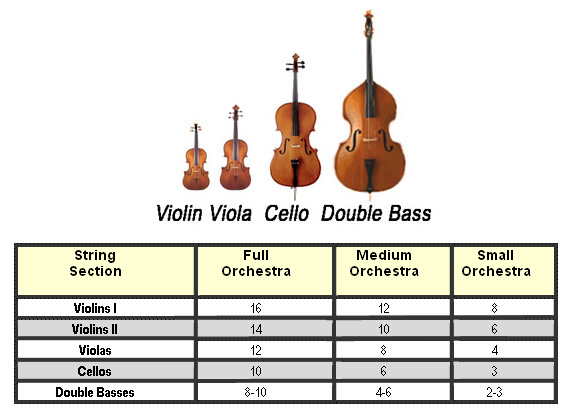 In larger orchestras, the number of first violins may amount to 20 and even 24, the other strings being increased proportionately. But such a great quantity of strings over-powers the customary wood-wind section, and entails re-enforcing the latter. Sometimes orchestras contain less than 8 first violins; this is a mistake, as the balance between strings and wind is completely destroyed. In writing for the orchestra it is advisable to rely on a medium-sized body of strings. Played by a larger orchestra a work will be heard to greater advantage; played by a smaller one, the harm done will be minimized.
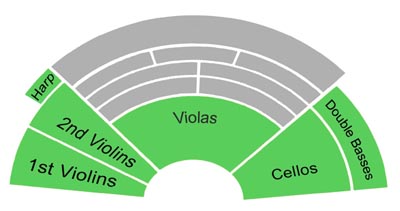 Suggestion Position of Strings in the Orchestra Video of Violins Playing in an Orchestra Video of Cellos Playing in an Orchestra Video of Double Basses Playing in an Orchestra Whenever a group of strings is written for more than five parts-without taking double notes or chords into consideration-these parts may be increased by dividing each one into two, three and four sections, or even more (divisi). Generally, one or more of the principal parts is split up, the first or second violins, violas or violincellos. The players are then divided by desks, numbers 1, 3, 5 etc. playing the upper part, and 2, 4, 6 etc., the lower; or else the musician on the right-hand of each desk plays the top line, the one on the left the bottom line. Dividing by threes is less easy, as the number of players in one group is not always divisible by three, and hence the difficulty of obtaining proper balance. (*1)
Nevertheless there are cases where the composer should not hesitate to employ this method of dividing the strings, leaving it to the conductor to ensure equality of tone. It is always as well to mark how the passage is to be divided in the score; Vlns I, 1, 2, 3 desks, 6 'Cellos div. A 3, and so on Division into four and more parts is rare, but may be used in piano passages, as it greatly reduces volume of tone in the group of strings.
Possible combinations less frequently used are:
  Note: It is evident that the tone quality in b and e will be similar. Still b is preferable since the number of Vns II (14-10-6) and Violas (12-8-4) is practically the same, the respective roles of the two groups are more closely allied, and from the fact that second violins generally sit nearer to the violas than the first, thereby guaranteeing greater unity in power and execution. Note: It is evident that the tone quality in b and e will be similar. Still b is preferable since the number of Vns II (14-10-6) and Violas (12-8-4) is practically the same, the respective roles of the two groups are more closely allied, and from the fact that second violins generally sit nearer to the violas than the first, thereby guaranteeing greater unity in power and execution.The reader will find all manner of divisions in the musical examples given in Vol. II. Where necessary, some explanation as to the method of dividing strings will follow in due course. I dwell on the subject here in order to show how the usual composition of the string quartet may be altered.
Stringed instruments possess more ways of producing sound than any other orchestral group. They can pass, better than other instruments from one shade of expression to another, the varieties being of an infinite number. Species of bowing such as legato, detached, staccato, spiccato, portamento, martellato, light staccato, saltando, attack at the nut and at the point,
From the point of view of activity and flexibility the violin takes pride of place among stringed instruments, then, in order, come the viola, 'cello and double bass. In practice the notes of extreme limit in the string quartet should be fixed as follows:  and V V V(down bow and up bow), in every degree of tone, fortissimo, pianissimo, crescendo, diminuendo, sforzando, morendo-all this belongs to the natural realm of the string quartet. (*2) and V V V(down bow and up bow), in every degree of tone, fortissimo, pianissimo, crescendo, diminuendo, sforzando, morendo-all this belongs to the natural realm of the string quartet. (*2)The fact that these instruments are capable of playing double notes and full chords across three and four strings-to say nothing of sub-division of parts-renders them not only melodic but also harmonic in character (1). Note: (1) To give a list of easy three and four-note chords or to explain the different methods of bowing does not come within the scope of the present book.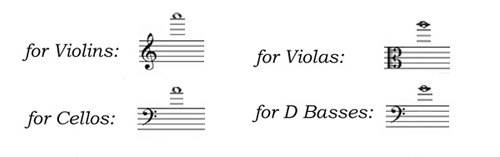 Higher notes given in Table A, should only be used with caution, that is to say when they are of long value, in tremolando, slow, flowing melodies, in not too rapid sequence of scales, and in passages of repeated notes. Skips should always be avoided.
A limit should be set to the use of a high note on any one of the three lower strings on violins, violas and 'cellos. This note should be the one in the fourth position, either the octave note or the ninth of the open string.
Nobility, warmth, and equality of tone from one end of the scale to the other are qualities common to all stringed instruments, and render them essentially superior to instruments of other groups. Further, each string has a distinctive character of its own, difficult to define in words. The top string on the violin (E) is brilliant in character, that of the viola (A) is more biting in quality and slightly nasal; the highest string on the 'cello (A) is bright and possesses a 'chest-voice" timbre. The A and D strings on the violin and the D string on the violas and 'cellos are somewhat sweeter and weaker in tone than the others. Covered strings (G), on the violin (G and C), on the viola and 'cello are rather harsh. Speaking generally, the double bass is equally resonant throughout, slightly duller on the two lower strings (E and A), and more penetrating on the upper ones (D and G). 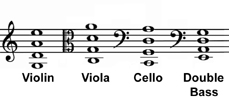 Open Strings of the Stringed Instruments The rare ability to connect sounds, or a series of sounds, the vibration of stopped strings combined with their above-named qualities-warmth and nobility of tone-renders this group of instruments far and away the best orchestral medium of melodic expression. At the same time, that portion of their range situated beyond the limits of the human voice, e. g. notes on the violin higher than the extreme top note of the soprano voice, from 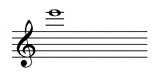  (written sound) lose in expression and warmth of tone. Open strings are clearer and more powerful but less expressive than stopped strings. Comparing the range of each stringed instrument with that of the human voice, we may assign: to the violin, the soprano and contralto voice plus a much higher range; to the viola, the contra alto and tenor voice plus a much higher register; to the 'cello, the tenor and bass voices plus a higher register; to the double bass, the bass voice plus a lower range. The use of harmonics, the mute, and some special devices in bowing produce great difference in the resonance and tone quality of all these instruments. (*3) Harmonics, frequently used to day, alter the timbre of a stringed instrument to a very appreciable extent. Cold and transparent in soft passages, cold and brilliant in loud ones, and offering but little chance for expression, they form no fundamental part of orchestral writing, and are used simply for ornament. Owing to their lack of resonant power they should be used sparingly, and, when employed, should never be overpowered by other instruments. As a rule harmonics are employed on sustained notes, tremolando, or here and there for brilliant effects; they are rarely used in extremely simple melodies. Owing to a certain tonal affinity with the flute they may be said to form a kind of link between string and wood-wind instruments. Another radical change is effected by the use of mutes. When muted, the clear, singing tone of the strings becomes dull in soft passages, turns to a slight hiss or whistle in loud ones, and the volume of tone is always greatly reduced. (*4)
The position of the bow on the string will affect the resonance of an instrument. Playing with the bow close to the bridge (sul ponticello), chiefly used tremolando, produces a metallic sound; playing on the finger-board (sul tasto, flautando) creates a dull, veiled effect. Note: Another absolutely different sound results from playing with the back or wood of the bow (col legno). This produces a sound like a xylophone or a hollow pizzicato. It is discussed under the heading of instruments of little sustaining power. The five sets of strings with number of players given above produce a fairly even balance of tone. If there is any surplus of strength it must be on the side of the first violins, as they must be heard distinctly on account of the important part they play in the harmonic scheme. Besides this, an extra desk of first violins is usual in all orchestras, and as a general rule they possess a more powerful tone than second violins. The latter, with the violas, play a secondary part, and do not stand out so prominently. The 'cellos and double basses are heard more distinctly, and in the majority of cases form the bass in octaves. In conclusion, it may be said that the group of strings, as a melodic element, is able to perform all manner of passages, rapid and interrupted phrases of every description, diatonic or chromatic in character. Capable of sustaining notes without difficulty, of playing chords of three and four notes; adapted to the infinite variety of shades of expression, and easily divisible into numerous sundry parts, the string group in an orchestra may be considered as a harmonic element particularly rich in resource. 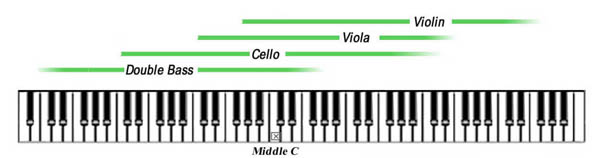 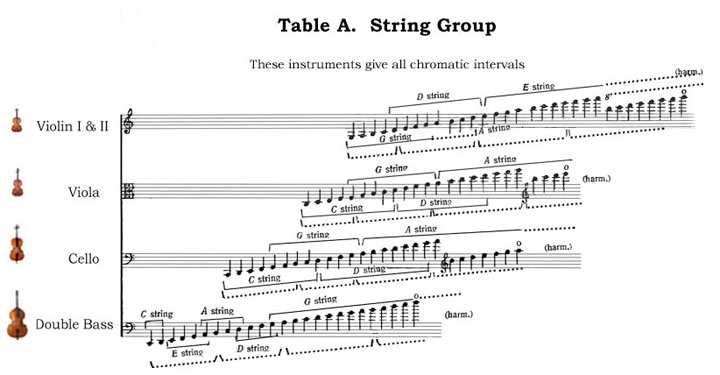 Black lines on each string denote the general range in orchestral writing; the dotted lines give the registers, low, medium, high, very high. B. Wind Instruments. Wood-wind. 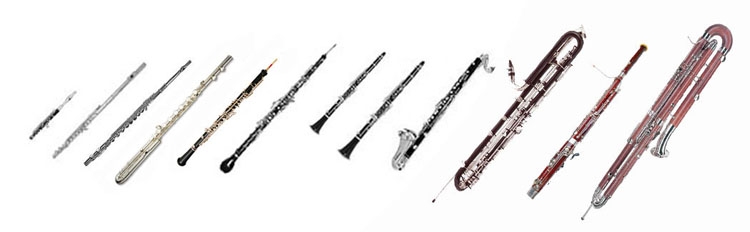 Apart from the varying number of players, the formation of the string group, with its five constituent parts remains constant, satisfying the demands of any orchestral full score. On the other hand the group of wood-wind instruments varies both as regards number of parts and the volume of tone at its command, and here the composer may choose at will. The group may be divided into three general classes: wood-wind instruments in pair's, in three's and in four's (see table below).
Arabic numerals denote the number of players on each instrument; roman figures, the parts (1st, 2nd etc.). Instruments which do not require additional players, but are taken over by one or the other executant in place of his usual instrument, are enclosed in brackets. As a rule the first flute, first oboe, first clarinet and first bassoon never change instruments; considering the importance of their parts it is not advisable for them to turn from one mouthpiece to another. The parts written for piccolo, bass flute, English horn, small clarinet, bass clarinet and double bassoon are taken by the second and third players in each group, who are more accustomed to using these instruments of a special nature. (*5)
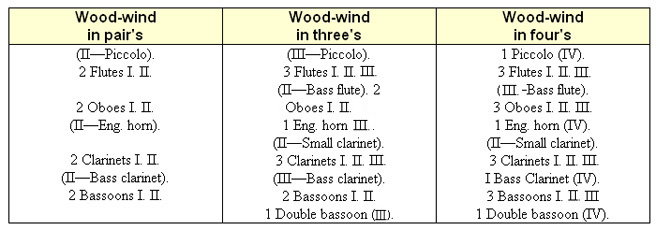 The formation of the first class may be altered by the permanent addition of a piccolo part. Sometimes a composer writes for two piccolos or two English horns etc. without increasing the original number of players required (in three's or four's).
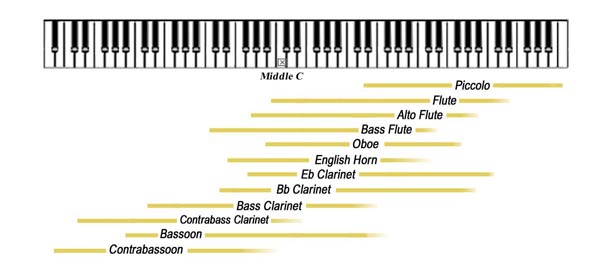
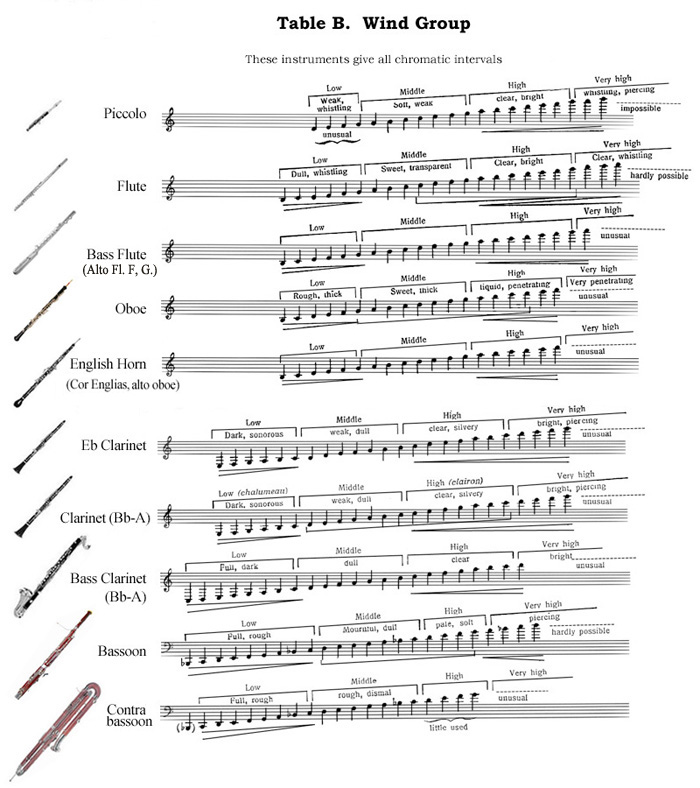
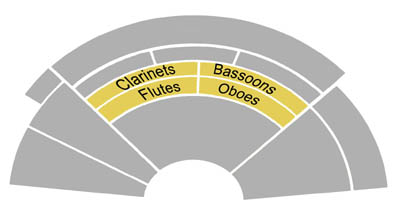 Suggested Position of Woodwinds in an Orchestra (positions may vary depending on the work,the venue, the orchestra and other factors) In each wind instrument I have defined the scope of greatest expression, that is to say the range in which the instrument is best qualified to achieve the various grades of tone, (forte, piano, cresc., dim., sforzando, morendo, etc.)-the register which admits of the most expressive playing, in the truest sense of the word. Outside this range, a wind instrument is more notable for richness of color than for expression. I am probably the originator of the term "scope of greatest expression". It does not apply to the piccolo and double bassoon which represent the two extremes of the orchestral compass. They do not possess such a register and belong to the body of highly-colored but non-expressive instruments.
The four kinds of wind instruments: flutes, oboes, clarinets and bassoons may be generally considered to be of equal power. The same cannot be said of instruments which fulfill a special purpose: piccolo, bass flute, English horn, small clarinet, bass clarinet and double bassoon, Each of these instruments has four registers: low, middle, high and extremely high, each of which is characterized by certain differences of quality and power. It is difficult to define the exact limits of each register; adjacent registers almost blend together and the passage from one to another is scarcely noticeable. But when the instrument jumps from one register to another the difference in power and quality of tone is very striking.
The four families of wind instruments may be divided into two classes:
These characteristics of color and resonance-expressed in too simple and rudimentary a form-are especially noticeable in the middle and upper registers. The lower register of the oboes and bassoons is thick and rough, yet still nasal in quality; the very high compass is shrill, hard and dry. The clear resonance of the flutes and clarinets acquires something nasal and dark in the lower compass; in the very high register it becomes somewhat piercing.
Flutes and clarinets are the most flexible wood-wind instruments (the flutes in particular), but for expressive power and subtlety in nuances the clarinet supersedes them; this instrument can reduce volume of tone to a mere breath. The nasal instruments, oboe and bassoon, are less mobile and supple; this is accounted for by their double reed, but, having to effect all sorts of scales and rapid passages in common with the flutes and clarinets, oboes and bassoons may be considered melodic instruments in the real sense of the word, only of a more cantabile and peaceful character. In very quick passages they often double the flutes, clarinets or strings.
The four families are equally capable of legato and staccato playing and changing from one to the other in different ways, but distinct and penetrating staccato passages are better suited to the oboes and bassoons, while the flutes and clarinets excel in well-sustained legato phrases. Composite legato passages should be allotted to the first two instruments, composite staccato passages to the latter pair, but these general directions should not deter the orchestrator from adopting the opposite plan. In comparing the technical individualities of the wood-wind the following fundamental differences should be noted:
Wood-wind players cannot manage extremely long sustained passages, as they are compelled to take breath; care must be taken therefore to give them a little rest from time to time. This is unnecessary in the case of string players. In the endeavor to characterize the timbre of each instrument typical of the four families, from a psychological point of view, I do not hesitate to make the following general remarks which apply generally to the middle and upper registers of each instrument:
In the extreme registers these instruments convey the following impressions to my mind
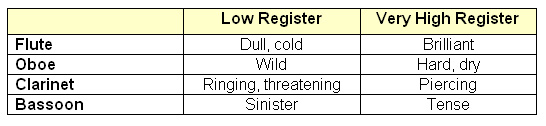
The following remarks illustrate the characteristics, timbre, and employment of special instruments:
The duty of the piccolo and small clarinet is, principally, to extend the range of the ordinary flute and clarinet in the high register. The whistling, piercing quality of the piccolo in its highest compass is extraordinarily powerful, but does not lend itself to more moderate shades of expression. The small clarinet in its highest register is more penetrating than the ordinary clarinet. The low and middle range of the piccolo and small clarinet correspond to the same register in the normal flute and clarinet, but the tone is so much weaker that it is of little service in those regions. The double bassoon extends the range of the ordinary bassoon in the low register. The characteristics of the bassoon's low compass are still further accentuated in the corresponding range of the double bassoon, but the middle and upper registers of the latter are by no means so useful. The very deep notes of the double bassoon are remarkably thick and dense in quality, very powerful in piano passages.
The English horn or alto oboe (oboe in F) is similar in tone to the ordinary oboe, the listless, dreamy quality of its timbre being sweet in the extreme. In the low register it is fairly penetrating. The bass clarinet, though strongly resembling the ordinary clarinet, is of darker color in the low register and lacks the silvery quality in the upper notes; it is incapable of joyful expression. The bass flute is an instrument seldom used even today; it possesses the same features as the flute, but it is colder in color, and crystalline in the middle and high regions. These three particular instruments, apart from extending the low registers of the instruments to which they belong, have their own distinctive peculiarities of timbre, and are often used in the orchestra, as solo instruments, clearly exposed.
Of late years the habit of muting the wood-wind has come into fashion. This is done by inserting a soft pad, or a piece of rolled-up cloth into the bell of the instrument. Mutes deaden the tone of oboes, Eng. horns, and bassoons to such an extent that it is possible for these instruments to attain the extreme limit of pianissimo playing. The muting of clarinets is unnecessary, as they can play quite softly enough without artificial means. Is has not yet been discovered how to mute the flutes; such a discovery' would render great service to the piccolo. The lowest note on the bassoon:
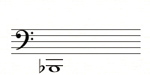 and on the oboe and English horn: 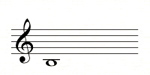 are impossible when the instruments are muted. Mutes have no effect in the highest register of wind instruments. (*6) Professor Comments:
|
